Sunday, February 21, 2016

The FBI, Apple, and the Importance of Jurisdiction

Jurisdiction is important when dealing with the law.  Courts as a rule do not have the power to decide every issue brought before them.  A small claims court can’t decide a million-dollar contract dispute.  An Alaskan state court can’t evict a tenant living in Manhattan.  A federal court typically does not have jurisdiction over purely state law criminal prosecutions.  Jurisdiction, in other words, is extremely meaningful.  And jurisdiction just might play an important role in deciding the present dispute between the FBI and Apple about the San Bernardino shooter’s iPhone.

The scenario reads like a thorny law school exam fact pattern.  The FBI holds a seized iPhone used by one of the terrorists who killed 14 of his co-workers in San Bernardino in December 2015.  The phone belongs to his employer, which has given its consent to a search of the phone and its data.  The data on the phone is encrypted, and cannot be read by the FBI.  The phone is password-protected, and if the FBI makes more than 10 incorrect password guesses, there is a very strong danger that the current encryption key will be destroyed and the phone’s data will, for all practical purposes, become unrecoverable. 

Apple owns the phone’s operating system.  It is uniquely positioned to help the FBI by revising the phone’s software to disable the 10-or-dead feature.  The FBI has requested Apple’s help; Apple has refused, and the FBI has secured a court order directing Apple to assist the FBI.  Apple, in an open letter to its customers, indicated it will challenge the order, citing its concerns about building what it says is a currently-nonexistent “backdoor” into its iOS operating system that could compromise security for its millions of users worldwide. 

In its application to the court, the FBI argued that the proposed software would only be usable for this one iPhone, because it would be keyed to the specific hardware id associated with that iPhone.  Apple quite clearly disagrees: “But that’s simply not true. Once created, the technique could be used over and over again, on any number of devices. In the physical world, it would be the equivalent of a master key, capable of opening hundreds of millions of locks — from restaurants and banks to stores and homes. No reasonable person would find that acceptable.”

Apple’s concern for the privacy of its users appears to be reasonable.  If it is forced to develop software designed to defeat the 10-or-dead feature on this one iPhone, that software could work on any iPhone, provided that iPhone’s unique id is substituted for that of the phone used by the San Bernardino shooter – a relatively trivial change.  A flood of court orders compelling Apple to use the same software for other locked iPhones could follow.   

The dispute shines a spotlight on important privacy issues that affect all of us.  Tech companies and the government have been arguing for years about encryption.  The tug-of-war between the need to keep user information private and the government’s need to investigate crimes has been the subject of ongoing debate.  The recent revelations about the extent of warrantless government surveillance has shone a spotlight on what many believe are abuses by the government of citizen privacy, and has resulted in stronger encryption regimes for consumer communications devices and systems.

In the Apple case, the order sought by the FBI (read the FBI's application here) was signed the very same day the FBI asked for it, which suggests that the court simply accepted the FBI’s argument without giving it too much scrutiny.  (The order was sought ex-parte, without Apple’s participation.)  The FBI relies on the All Writs Act, a law dating from our nation’s infancy, to support its request.  The act is sort of a catch-all for federal courts, providing that “The Supreme Court and all courts established by Act of Congress may issue all writs necessary or appropriate in aid of their respective jurisdictions and agreeable to the usages and principles of law.”  The government argued, and the district court agreed, that the act empowered the court to issue its order directing Apple to help the government defeat the 10-or-dead feature on the San Bernardino iPhone so that the government may attempt to crack the phone’s password. 

Apple has not yet filed its opposition to the court’s order.  There are a number of arguments it can be expected to raise; some of them were highlighted in its customer letter: “If the government can use the All Writs Act to make it easier to unlock your iPhone, it would have the power to reach into anyone’s device to capture their data. The government could extend this breach of privacy and demand that Apple build surveillance software to intercept your messages, access your health records or financial data, track your location, or even access your phone’s microphone or camera without your knowledge.”

One potential argument not mentioned by Apple is that the court’s grant of the FBI’s request is an impermissible application of the All Writs Act because the order was not “necessary or appropriate in the aid of” the court’s jurisdiction.  This argument formed the basis of the dissent to one of the key cases the FBI relies upon,  United States v New York Telephone Co., 434 US159 (1977)

In New York Telephone, the Supreme Court in a 5-4 decision held that the district court had the power to issue an order under the All Writs Act directing New York Telephone to lease certain phone lines to the FBI to permit it to secretly install a pen register to record phone numbers dialed by a suspected gambling operation in New York City.  In his dissent, Justice  Stevens argued that this was an improper extension of the act’s scope because the order requested by the FBI in that case was not one that would “be in the aid of [the court’s] duties and [the court’s] jurisdiction.”  434 US at 189.  “The fact that a party may be better able to effectuate its rights or duties if a writ is issued never has been, and under the language of the statute cannot be, a sufficient basis for issuance of the writ.” Id. (my emphasis).    

The following paragraph from the dissent could have been written to cover this very situation: 

Nowhere in the Court's decision or in the decisions of the lower courts is there the slightest indication of why a writ is necessary or appropriate in this case to aid the District Court's jurisdiction. According to the Court, the writ is necessary because the Company's refusal "threatened obstruction of an investigation . . . ."  Concededly, citizen cooperation is always a desired element in any government investigation, and lack of cooperation may thwart such an investigation, even though it is legitimate and judicially sanctioned.  But unless the Court is of the opinion that the District Court's interest in its jurisdiction was coextensive with the Government's interest in a successful investigation, there is simply no basis for concluding that the inability of the Government to achieve the purposes for which it obtained the pen register order in any way detracted from or threatened the District Court's jurisdiction. Plainly, the District Court's jurisdiction does not ride on the Government's shoulders until successful completion of an electronic surveillance.
Id. at 190 (my emphasis). 


Admittedly, this was the losing side’s argument in the New York Telephone case.  But it has the attractiveness of being rooted in the actual language of the All Writs Act.  Given recent revelations about the extent to which the government has abused the privacy rights of its citizens, Justice Stevens’s prescient concern in the New York Telephone dissent is apt today:  “Nevertheless, the order is deeply troubling as a portent of the powers that future courts may find lurking in the arcane language of Rule 41 [covering Search and Seizure] and the All Writs Act.”

Saturday, November 14, 2015

Using Public WiFi? Use a VPN - or Else

We all use public WiFi. Coffee shops, hotels, public spaces, even the New York subway system offer easy and free WiFi connections that allow us to stay connected to the Internet while away from the office. The vast majority of these public WiFi networks are insecure, however, meaning that an unknown third party using easily-available tools can snoop on our conversations with relative ease. And while many email providers and some websites will secure (that is, encrypt) your communications for you (look for the "https" at the top of your browser), that doesn't cover everything you're typically doing on the Internet.

Enter the Virtual Private Network, or VPN.

A VPN is a secure, encrypted connection between your computer and the VPN provider's server, which can be located anywhere but most certainly is not located on the laptop of that sketchy-looking guy camped out two tables over.  It protects all of your communications with the Internet, making it much more difficult for nefarious snoopers like Mr. Sketchy to see what you're up to while, for example, you're searching for prior art or doing legal research at your local Peets (alright, it's probably a Starbucks but I've always liked Peet's).

Using a VPN requires subscribing to a VPN service.  I use VPNLand, because the BoingBoing store offered a good deal ($24.99) on a lifetime subscription and it seemed to have good reviews.  There are many, many other providers, so do your homework and look for one with favorable reviews.  Once you sign up, you'll download a VPN app that you access after you've made your insecure WiFi connection. VPN apps are also available for smartphones, but I do most of my heavy lifting on my laptop, so that was not important to me.  

With my VPNLand app installed, I connect to the Internet, open it up, select my encryption level, and then select my server location. For most work, any encryption level will do and server location isn't all that important; I typically select a server located in New Jersey, simply because of a probably-naive belief that a shorter connection might mean marginally faster service. I click connect, and in a matter of less than a minute my Internet connection is securely routed through a VPNLand server in the Garden State.

Of course, you can geek out with a VPN - select an encryption protocol that is more secure than another, pick a server located in another country - but for the vast majority of us, any type of encryption and any server location is going to be good enough.  There are many benefits of a VPN that go beyond the scope of this post.  Three worth briefly noting here: (1) If you're traveling in a country that restricts Internet access, you can select a server located in a more open jurisdiction; (2) many countries block Skype, and a VPN will help you get around that, and (3) If you are outside of the US and can't access a particular site (Netflix, for example) because you are not in the US, you can use a US-based server to connect. Finally, for the small subset of us who have clients with particularly good reasons for secure communications (international human rights, for example), a VPN connection might be something you want to use even when working from a more secure office setting.  

For lawyers working on client matters, there is no excuse for not using a VPN.  For anyone else interested in keeping their communications secure, it's a must.


Saturday, October 24, 2015

Fairly Unsurprising - the Google Books Decision

With its recent Google Books decision, the Second Circuit hasn’t necessarily broken new ground so much as – doing what courts from time immemorial have always done – applied existing law to a new situation.  The result, within this very discrete set of facts, can be summarized thus: 

- Full-text imaging and OCR-ing of books is okay if you do it for someone who owns a copy of that book and won’t use the scanned version to infringe the author’s rights.  Permitting the public to search the full text of the book falls within the fair use doctrine, provided the search results you provide are of only small portions of the book, do not substantially harm the market for the book (such as when an entire recipe is revealed from a cookbook), and you don't make money from the process.  

This all seems quite reasonable, and may provide some new guidance for fair use advocates.  Its very reasonableness, however, makes it a wee bit suspect, since much of the existing law of copyright has very little to do with reasonableness and very much to do with what major content owners think it should be.  

If the Supreme Court considers and upholds the Second Circuit decision, look for content owners to lobby Congress for a legislative “fix” that will close what I’m sure many will consider to be an undesirable result.  

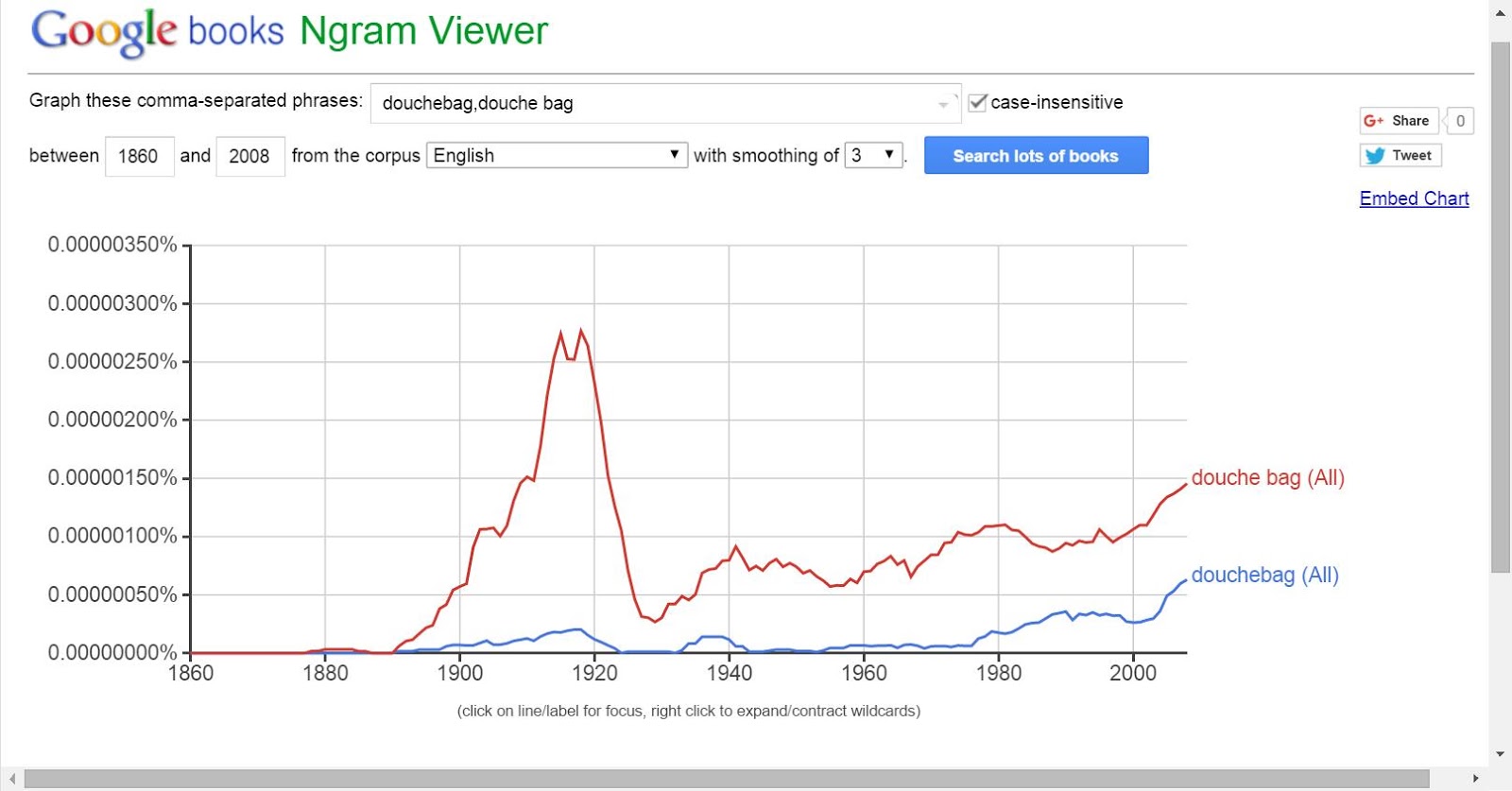
In the meantime, my personal takeaway from the Google Books decision is the existence of the Google Ngram viewer, which charts the frequency of word use over time among the many books that Google has scanned.  In the interest of scholarship, I offer the results of my own thoughtful exploration of this feature below.  


Sunday, October 11, 2015

And to Your Right - the TTIP

With all the news about the Trans-Pacific Partnership (TTP) and debate about its effects on intellectual property and Internet user rights, we should also keep in mind another huge trade deal that is in mid-negotiation: the Transatlantic Trade and Investment Partnership, or TTIP, between the US and the EU.  The TTIP is not nearly as far along as the TPP, but because of its similar potential to have a huge impact the US it also bears watching.

The TTIP has inspired huge protests in the EU, with hundreds of thousands of people gathering to protest it this past week in Berlin and other cities in Europe, and more than 3.2 million people signing an anti-TTIP petition that was delivered last week to the European Commission.  Many of the protestors' concerns relate to the TTIP's potential effect on European food safety and environmental laws, which are generally viewed to be tougher than those imposed in the US.

The TTIP isn't all about GMO and fracking, however.  It is intended to include provisions relating to intellectual property, and while they haven't been solidified yet, the Electronic Frontier Foundation nonetheless prepared a piece back in January of 2015 that nicely highlights some areas of potential concern.  

In any event, when that many people claim to oppose a trade deal that directly involves the US, it bears keeping an eye on what's going on.  The US media has been relatively quiet about the TTIP, so if you want to follow along you'll be best served to see what the international press has to say about it.


Good Points on the TPP from the EFF

The Electronic Frontier Foundation has penned an excellent analysis of the IP provisions of the Trans-Pacific Partnership text that you can read in full here.

Something that I did not appreciate when I read the leaked language of the IP section was how the restrictions applied to users tend to be mandatory, while the rights given to them tend to be discretionary.  Which of course makes sense if you accept the contention that major content providers significantly influenced the (secret) negotiations the led to the TPP.  

Frankly, much of the IP language of the TPP tends to impose the regimes currently in place in the US, which is why it may be harder for me to be shocked to see them in this document.  At any rate, the EFF's analysis offers a fresh perspective on what the appropriate limits should be on both content owner rights and user rights.  Good reading.

Saturday, October 10, 2015

Let's Take Our Time Before We Freak Out About the TPP

While I am not a big fan of the way the Trans-Pacific Partnership Agreement was negotiated or has been ballyhooed by the Obama administration, the fact remains that it is the text of the TPP that needs to be the focus of our attention going forward.
Wikileaks has just released a the IP Rights Chapter of the TPP, or at least the version that existed as of October 5, 2015. 
Based on the version released by Wikileaks, The Guardian article linked here says that the TPP will "give signatories the ability to curtail legal proceedings if the theft of information is 'detrimental to a party’s economic interests, international relations, or national defense or national security' – in other words, presumably, if a trial would cause the information to spread."
I'm not sure I agree. The text in question (Article Q.Q.H.8.3) says that "a Party (any of the countries who sign on to the TPP) may, where appropriate, limit the availability of such criminal procedures [to prosecute trade secret theft], or limit the level of penalties available, TO one or more of the following cases: . . . . (e) the acts are detrimental to a Party's economic interest, international relations, or national defense or national security."
Note the "TO," which I highlighted. This suggests that a country may limit its criminal prosecution of trade secret theft TO situations where the theft is detrimental to the country's economic interest.
The Guardian's interpretation effectively replaces the word "TO" with the word "IN." Doing so substantially changes the meaning of this section. If a country can "limit the availability of such criminal procedures . . . IN . . . one or more of the following cases," then the country can restrict application of existing laws in situations where "the acts are detrimental to a Party's economic interest" etc.
But I don't think that's what the provision is trying to say.
Certainly this is one area that could use some clarification before it's up for ratification.

Tuesday, April 09, 2013

Selling a Jayne Cobb hat? Keep selling!

The short-lived Fox series "Firefly" has developed a cult following that has given life to any number of t-shirts, character statues, and other fan tributes.  Among them are a certain silly knit cap worn by the character Jayne Cobb (supposedly knit for him by his mother).  Fans have been able to buy "Jayne Cobb" hats from Etsy sellers and others for years.


(This is an official "Jayne Cobb" hat, available via ThinkGeek.  Attractive, no?) 

Until now. Apparently, Fox has been threatening these independent producers of lookalike hats with all manner of perdition.  But here's the problem - unless the sellers are calling them "Jayne Cobb" or "Firefly" or "Serenity" (the name of the ship and a follow-on feature film) hats, Fox really has little legal basis to stop third parties from making and selling these hats.

That's because hats are "useful articles" under US Copyright Law - and so can't be protected by copyright.  This peculiarity of copyright law has bedeviled fashion designers for years, and while there has been some chipping away of the concept (costumes, for example, can be protected), in general an article of clothing can't be.

So if you've received a cease-and-desist letter because you are selling "Jayne Cobb" hats, give me a call.  I'm a big "Firefly" fan and will be happy to review your situation and give you some idea of where you stand.   Browncoats do need to stick together, after all.  Especially when the Alliance comes a calling.  

(Update: The folks at ThinkGeek have decided to donate profits from the sales of officially-licensed Jayne Cobb hats to the Firefly-inspired "Can't Stop the Serenity" charity.  Well-played, Geeks, well-played!)

Monday, April 08, 2013

Bittorrent Subpoena Notice? Check the Case Status!

These pesky bittorrent lawsuits continue to propagate themselves throughout the court system.  Content owners -- which frankly may have a legitimate beef with having their films distributed for free -- persist in using them as tools to issue subpoenas seeking the identity of alleged file sharers.  If you receive a notice from your ISP that it has received a subpoena and that your personal information will be disclosed to the plaintiff unless you take steps to stop that from happening, don't despair.

One of the first things you should do is check the status of the lawsuit.  Many of these cases are getting dismissed by judges who are increasingly skeptical of both the methods used by the plaintiffs, and the quality of the rights they claim to hold.  If your case has recently been dismissed, then you may have a great argument that the subpoena is no longer valid.  Even the most compliant of ISPs will be nervous about disclosing customer information in response to a subpoena that has no legal force.

Those of us who handle these cases can quickly let you know what the status of the underlying lawsuit is.  Make sure you double check that before deciding how to respond to the ISP notice.


Saturday, October 06, 2012

NBC, Get with the Program

NBC has recently asked the Obama campaign to stop using footage of one of its talking heads reporting on what a think tank thinks of Romney's tax plan.  And yes, perhaps NBC has something of a copyright claim, and yes, perhaps NBC wants to avoid the impression that it is taking sides in the election.

But if you are a broadcast network built on the backs of licenses granted by the Federal Government allowing exclusive use of defined portions of the broadcast frequency spectrum in return for providing a minuscule bit of public service programming, then you need to expect that a political campaign for president is going to use footage of one of your reporters reporting on an issue of interest.  And then just shut up about it.

Thursday, September 27, 2012

Are You Being Watched?

This Wired post reveals the extent to which warrantless spying by the Justice Department has exploded over the past decade.  I'm not sure it matters who you're voting for this election; but it's clear things have accelerated in the past four years.

With the explosion of surveillance comes an explosion of banal jobs consisting of sifting through the vast amounts of nonsense that most of us generate in the course of our everyday Internet lives.  I pity the poor fool who is charged with reviewing my latest Facebook bon mot, and only hope that I'm able to entertain him or her in the way I hope to entertain both of my Facebook 'friends.'

Sunday, September 16, 2012

This is Why I do What I do

When a major NYC law firm manages to run up $3.1 million in fees while "helping" a client recover a $4.68 million down payment on a condo, whilst billing more than 5500 billable hours - well, you know that the system is broken.  Read it and weep here.

Here's a clue: lawyers should be in business to help their clients achieve sensible results to their real-world problems.  When clients are spending stupid amounts of money to achieve these results, we have an obligation to let them know they may be wasting their funds.

This looks like one of those cases where the lawyers may have told the client "Don't worry; our fees are recoverable."  As the court found in its opinion:

"[I]t appears that Sponsor has not actually paid any legal fees to [the firm] on this matter. Astonishingly, [the firm's] attorneys, paralegals, and staff amassed 5536.4 billable hours on this matter, employing four partners, three special counsel, ten associates, eight paralegals, and a summer associate. (See Declaration of [nameless lawyer], dated Aug. 23, 2012 . . . . . Partners billed their time at rates ranging from $6801hour to $1025Ihour; associates at rates ranging from $440/hour to $745/hour; paralegals at rates ranging from $250/hour to $295/hour; and, last but not least, a summer associate at $335/hour. [The firm's] total bill for legal fees is a breathtaking $3,164,828.00."

As Judge Pauley put it, "This Court doubts that Sponsor - or any other client-would pay over $3.3 million in fees and expenses for the mere possibility of securing a $4.68 million down payment."

Don't get me wrong - the firm involved here is a well-known, high-quality, top-tier firm that is capable of providing great legal work for its clients.  But at some point the Rule of Reason needs to intervene.  And what this means from a practical perspective is that the Big Name Law Firm is not always your best choice for a good result at a good price.  


Tuesday, September 11, 2012

Remembering

What has 9/11 wrought?  Did it bring us closer together as a nation?  Briefly.  Then it became an excuse - for warrantless searches and surveillance; for intrusive, meaningless security theater in our transportation systems; for questionable military actions that have killed many times more than perished on that terrible day; for the outsourcing of torture under the guise of 'rendition,' and for our own acts of torture and indefinite detention.

Of course we should never forget those who perished and those who risked and lost their lives to save them.  But we should also question the country we have become in the years after.  

Sunday, September 09, 2012

Dr. Seuss in Advertising


In the early days, pre-Cat, pre-Sneetches
Dr. Seuss was not living life on the beaches,
A mad-man was he, pitching that, pitching this,
To generate cash, and familial bliss. 


(Click each logo you see on the website below
and to the Dr. Seuss ads for that company you'll go!)

Official Web site of the University of California, San Diego
A UCSD Libraries Website
Part of the Dr. Seuss Collection
Presented by the Mandeville Special Collections Library


Friday, September 07, 2012

Auto(complete)?

I supp(orthose) I can't really argue with former German first lady Bettina W(oof, woof woooooof, awooooooo)ulff's lawsuit against Google for the manner in which its autocomplete feature managed to tack on words such as "escort" and "prostitute" to her name in search results.  I mean, I'm sure if when someone started Googling "Kelly" the phrase "green dildo" or "loves small animals" immediately popped up, I'd be irritated too.  Especially if I had absolutely nothing whatsoever to do with green dildos, or small animals.  Which I don't.  I swear. No, really.

Now go away.  Don't you have a college football score to check or something?

Chris Kluwe Rocks

Yes it's foul.  Yes it's irreverent.  Yes it's foul.  (That's how foul it is.)  But NFL punter Chris Kluwe's rant against a homophobic Maryland state delegate deserves to be read.  Enjoy.  NSFW if you are still sounding out your words.

Thursday, September 06, 2012

Keeping it Classy

After such a long hiatus, I want to come out of the box with something that will set the standard for future posts; something that I can look back on and say to myself "Self, THAT'S what legal blogging is all about;" something I can be proud to show the kids and their grandparents.

Which means, of course, we're going to talk about porn.

Not just any porn, mind you.  Ice cream porn.

I don't know about you, but regular porn bores me.  I mean, I no matter how much of the stuff I watch, it all seems the same to me.  I've tried, and tried, and tried but just don't get it; Part A plugs in to Part B and/or Part C, except for the occasional brush with Parts D, E, or F . . . blah, blah, blah.  To quote Lilly von Schtupp: "I'm had my fill of love . . . from below and above."

The folks at Rodax Distributors and Caballero Videos apparently were aware of this growing sense of ennui among the porn cognoscenti.  I can see the think tank in action now: "Okay folks, our sales are down.  Pizza delivery guys showing up with extra pepperoni just aren't cutting it anymore.  We need a gimmick; something to draw attention to . . . Spencer, what are you eating?  Ice cream?  Wait a minute . . . I've GOT IT!"

And thus, perhaps, was born the "Ben & Cherry's" line of porn films, complete with packaging uncomfortably reminiscent of "Ben & Jerry's" ice cream containers, and featuring cleverly titillating titles such as "Boston Cream Thigh," "Hairy Garcia," and "Peanut Butter D-Cup."

(Here is the point at which I step aside for a brief moment and allow the masters at the New York Post to tell you the rest of the juicy background stuff.  I'll wait.)


Having read about the case, I naturally went looking for a copy of the complaint to share with you, my dear reader.  This was completely in the interest of scholarly research, and had nothing to do with hoping that the complaint would include salacious images that could liven up my otherwise dull and dreary blog.

This is where things got a bit strange.  I had the case number (thanks to Bloomberg, which left out all the interesting bits covered by the Post, but did list the case number).  I went to the Southern District of New York Pacer site, but at least as of this morning the case number didn't yield any results at all.  It was like the case didn't exist; and I presume the folks at Bloomberg don't just make up SDNY case numbers.  

Things changed a bit later - the case appeared on the website, but even then, the complaint wasn't available.  Later this afternoon, an order appeared on the site - Unilever, which owns Ben & Jerry's (allowing the company founders, of course, to count their money and watch porn at their leisure), had secured a temporary restraining order against the defendants.

So that's good for the plaintiff, but where was the complaint?

Then, an order issued.  I can only imagine how the complaint must have circulated around the clerk's office -- it's now probably all dog-eared, with pages stuck together -- before somebody thought to call the judge and bring the thing to his attention.  At any rate, the judge, possibly in the interest of protecting the SDNY servers from crashing, has ordered as follows:

"1. Pending further order of the Court:

"a.  The Clerk is directed to redact all images (including without limitation Exhibit 6 to the declaration of David Stever, Exhibits 6, 7 and 8 to the complaint, and the image contained in paragraph 54 ofthe complaint) from the electronic versions of documents filed or offered for filing in this case, but shall preserve and file in hard copy, under seal (available to counsel for all parties), all redacted material.

"b.  The attorneys shall redact all images from electronic versions of documents filed on the CMlECF system, Such images shall be filed only in hard copy and under seal as above."

(Heheh . . . the order said "hard copy.")

Fortunately, the judge gives us legal voyeurs some cause for hope:

"3.  The Court is mindful of the qualified right of public access to court documents and is prepared to reconsider this temporary measure upon application."

Did you know you had a 'qualified right' to look at dirty pictures filed with the court?  Now you do.  So call me if you want to make an application to look at the now-forbidden images . . . I will work for ice cream.


Wednesday, September 05, 2012

A Renaissance?

It's obvious that I haven't posted for awhile, but I am hereby making a public commitment to significantly increasing the frequency of my posts, if only, to borrow from the inestimable Rumpole, to placate She Who Must Be Obeyed.  I would like to say that it's been all of those Supreme Court arguments and high-stakes preliminary injunction hearings that have been keeping me away from the keyboard, but that would not be truthful and as a lawyer, of course, I'm nothing if not truthful.  So I'll just come right out and admit to sloth and lack of dedication to my reader - you know who you are - and leave it at that.  

I'm also going to be playing around a bit with the focus of this blog, so please bear with me.  It doesn't take a genius to figure out that there are hundreds of blogs out there whose quick-typing, hyper-intelligent authors will bring you a keen analysis of tomorrow's legal news today.  Being neither quick-typing nor hyper-intelligent, I'm probably going to start working another angle going forward.

So stay tuned to this channel, and feel free to unleash your worst by way of comment.  I'm not saying I'll publish all of them, but even if I don't publish yours, you can take comfort in knowing that my ever-tenuous sense of self-worth will be bolstered just by seeing the email notice that your comment awaits my review.


Thursday, April 15, 2010

Patent Basics IV - The Parts of a Patent, and a Baby's Butt

Patent Basics IV

(This is the fourth post in my series on Patent Basics; the first three posts can be found here, here, and here. My previous series on Trademark Basics has been consolidated on my website at www.kdtalcott.com. Future "basics" series will cover copyrights and trade secrets.)

The Parts of a Patent

If you've done your prior art search and are still feel your idea is worth protecting, it's worth knowing a bit about the geography of the patent application. A patent has a number of sections, each of which has a specific purpose. While there's no need to memorize each and every one of these, it will be helpful to have some understanding of what the main sections are and why they're there. This will allow you to communicate more effectively with your patent counsel (or the Patent Office, if you're taking the task on yourself).

There are four main parts to every patent application. They end up appearing in the issued patent; take a look at one example here. (This patent is one of my favorite examples of a patent. It happens to be for a method and kit for painting using the posterior of an infant. That's correct: someone patented the idea of painting using a baby's butt. Depending on your situation (budding inventor or patent professional), that should either be cause for hope or despair. At any rate, given that we're focusing on structure there's no reason not to have a bit of fun along the way.)

The Cover Page

The first page of the patent is a busy place, with a number of categories of information that many people ignore, but which are in fact very useful for those who are searching for prior art, looking for particular types of patents, or wanting a quick synopsis of what the patent is supposed to cover.

The cover page information includes (in order) the name of the patent and its inventors; filing date information (so we can figure out when the term expires); any official adjustments that have been made to that term; information about any related patent applications; various categories of classification information that the Patent Office uses to help organize the millions of patents in its records (very helpful for searching for prior art); a list of other patents and prior art that the examiner considered during the examination of the application; the abstract (a one-paragraph summary of what the patent covers); and a representative drawing from the patent.

The Drawings

Most every patent includes one or more drawings. In the case of our baby butt patent, the first drawing (Fig. 1) provides us with an example of the fine art that one can create using a baby's rear end in place of a brush. The numbers you see on the drawing tie in to the written description of the invention in the Specification, and allow the reader to follow along while the Specification describes the drawing.

The second page of drawings (Figs.2 and 3) are flowcharts. (Note the three-step method for painting using a baby's rear: (1) prepare background media; (2) dip; and (3) stamp. Good thing we have that flowchart.) A flowchart is a very common way of visually displaying the method described in the Specification. Again, numbers on the flowchart will tie in to the description in the Specification.

Figures 4, 5, and 6 are more conventional drawings, these of the baby butt paint kit. (And you do need a kit to guide you through the intricate baby butt painting method.) Again, numbers tie the drawing to the description in the Specification.

The Specification

The Specification immediately follows the Drawings. Patent lawyers being the uber-hipsters that we are, we typically refer to this as “the Spec.” (While I will let you in on these trade secrets from time to time, I'll never reveal the secret handshake.)

The Specification is perhaps the most accessible part of the patent. It is written in narrative form, and should teach the invention to a person “of ordinary skill in the art.” When the art is microbiology, there are relatively few people who are “of ordinary skill in the art.” When the art is painting using parts of the human body, as in our example, all of us probably are of ordinary skill in the art.

The subsections of the Specification of the baby butt painting patent are typical, and help satisfy the legal requirements for a patent. The Field of the Invention describes the technical field covered by the invention. The Background of the Invention is meant to do just what it says: explain what the background is of the invention, and will explain the problem that the invention was designed to overcome. In our example, the problem was the fact that “there is no known kit available, or method associated therewith, to assist in creating a remembrance that results in a fine art end product which is not easily recognized as merely a remembrance.”

The Summary of the Invention provides a short description of what is included in the product or method described in the Specification. And the Brief Description of the Drawings will list each drawing and provide a short summary of what is shown in each.

The meat of the Specification is the Detailed Description of the Preferred Embodiment of the Invention. This is an extended narrative that should explain how the invention works, and should use and reference each of the drawings at one or more points. The “preferred embodiment” is typically the one that best reflects the new and hopefully patentable properties of the invention. In our example, the patent splits its description between about a paragraph and a half that describes the preferred embodiment of painting with a baby's hiney, and roughly three full columns describing the preferred embodiment of the kit for doing so. That is probably because there are only so many ways that one can paint using an infant's posterior in place of a brush, but many ways that one could configure a painting kit.

Often the Specification will also describe other embodiments of the invention. These may be ones that were invented during the development process, but were considered to be less favorable than the preferred embodiment. It is sometimes helpful to describe these so that they can be protected by the patent as well. This can broaden the coverage of the patent, making it harder for competitors to copy the idea by making slight variations on the method.

The Claims

The claims are the most difficult part of the patent for the non-lawyer to understand. They're also the most important part of the patent, because the claims are what define the invention. Everything up to the claims has been explanation and elaboration – but in the end, it is the claim set that courts look at when they make infringement determinations.

The two types of claims are independent claims – which stand on their own – and dependent claims, which feed off of and relate to independent claims. In our example, claim 1 is an independent claim:

1.A method of painting using the posterior of an infant, said method comprising the acts of:
providing a background media;
providing a paint supply;
dipping the posterior of the infant in said paint supply;
stamping the posterior on said background media to create stamping prints.

More about this in a bit. Claim 2 is a dependent claim:

2.A method as defined in claim 1, wherein:
said dipping and said stamping steps are repeated in sequence.

Claim 2 builds on claim 1, and everything that is in claim 1 is considered to be part of claim 2.

You may hear the word “limitations” used in connection with claims. Limitations are important part of a claim; consider them like ingredients in a recipe – if you leave one out, then arguably you're not making the same dish. In our claim 1, the limitations follow the words “comprising the acts of.” So if we dip another part of our baby in the paint (say the top of the head, being careful of the soft spot) and stamp that part on the background media, then we arguably are not practicing the patented invention. (Please note that this is greatly simplifying the process of reading claims and applying them to our potentially infringing method of painting with a baby.)

Knowing what goes into your patent application will help you communicate with your attorney about it, and will give you a better understanding of what is going on throughout the prosecution process. The next post in this series will outline the patent application process.

Sunday, March 28, 2010

Patent Basics III - Prior Art

(This is the third post in my series on Patent Basics; the first two posts can be found here and here. My previous series on Trademark Basics has been consolidated on my website at www.kdtalcott.com. Future "basics" series will cover copyrights and trade secrets.)

What is “Prior Art,” and Why Should I Look for It?

Patents are only awarded for inventions that are “novel” -- in other words, new. You won't be able to get a patent for the light bulb unless your version of the light bulb is an improvement over all of the other light bulbs that have ever been invented and disclosed in some way to the public. Those earlier versions of the light bulb are part of the “prior art.”

Inventors have an obligation to tell the Patent Office about any prior art that they're aware of that may relate to their inventions. But that of course is not the main reason for conducting a search to find possible prior art before you file your patent application. There are a number of more practical reasons for doing so.

Prior Art Search Benefits
  • A prior art search will help you figure out whether your invention is truly 'novel.' Why spend thousands of dollars on a patent application for an invention that someone else has already thought of?
  • A prior art search may help you refine and improve your invention. “Stand on the shoulders of giants,” so to speak, and see what others have done. Their work may inspire you to improve on your original idea.
  • A prior art search will show you what you may need to 'design around.' Since you can't patent what's already been invented, you may have to develop a different way of doing what your invention does in order to avoid infringing an existing patent. A workable design-around can be valuable if the owner of the prior art patent refuses to license their invention on reasonable terms. A design-around can then become a cost-effective way to compete with a product or process that is protected by such a prior art patent.
  • A prior art search will help you understand whether your invention is a significant improvement over existing inventions, or an incremental advance. In either case, that information will help you decide whether it is worth investing in the patent application for your idea. An incremental advance that overcomes a significant marketing or operational problem that exists with the prior art, for example, may be very valuable. On the other hand, if your idea does not add much value to the existing invention, you may decide to invest your money elsewhere.

How to Conduct the Prior Art Search

There are services that will conduct a prior art search for you, of course for a fee. The quality of these searches can vary widely, and often depend on how much you spend. One thing that I explain to every client is that nobody will conduct as thorough a prior art search as someone who is accused of patent infringement. In other words, a prior art search that is paid for by an inventor, and may cost hundreds of dollars, will not be as thorough as one conducted by an accused infringer that stands to lose millions of dollars in a patent infringement suit.

That's a fact that patent owners simply need to accept. A reasonably-priced, reasonably-thorough prior art search is likely to provide a good indication of existing, similar inventions that are out there. But it cannot be considered to be definitive.

The patent search services tend to be very adept at searching U.S. Patent Office records, which in many cases are an excellent source of prior art. Existing patents and published patent applications are likely to form the bulk of the results of most prior art searches from such a firm. If your invention is one that is in a 'traditional' line of inventions – in other words, not a business method – then a Patent Office-focused search may be sufficient.

If, however, the invention is in a new field of science or technology, or is a business method invention, you should make sure that the prior art search goes beyond the Patent Office, and includes areas where publicly-available information about the particular field of endeavor is likely to be found. This includes the Internet, but can also include key university libraries as well as foreign-based information sources.

In some cases – mainly in areas where the inventor is at the cutting edge of the technology – the inventor may be an excellent source of prior art. In any case, it's always a good idea to check with the inventor to find out what information he or she has about the existing state of the technology and other inventions that may be out there.

Where to Search

If you want to do some or all of your prior art searching yourself, here are some good places to start. Of course Google or some other comprehensive search engine is first, provided you are adept at crafting searches that will yield enough relevant 'hits.' Google also has its own patent search engine, available at http://www.google.com/patents, that is a great help insofar as it goes. Clicking on the “Advanced Search” option opens up a detailed search menu that you can use to help narrow down your search results. I have found, however, that Google Patents is not kept up to date, and many recently-issued patents and recently-published applications are not included in the scope of its search, making this otherwise excellent search tool something that is ultimately unreliable for prior art searching.

There is, of course, the United States Patent Office website at www.uspto.gov. The main page will give you a link to the Search section, where you will quickly learn that the PTO is not exactly on the forefront of intelligent search technology. Still the information is there, and if you know something about a particular inventor or company whose work may be part of the prior art, a PTO search may be an efficient way to see what they've patented. If you really want to dive in to the nitty-gritty of how to search using the PTO's patent classification system and other similar tools, you can look at what the PTO tells its examiners about searching prior art here: http://www.uspto.gov/web/offices/pac/mpep/documents/0900_904_02.htm .

Finally, don't forget that a foreign patent or invention disclosure can also be prior art. There are a number of databases where you can conduct a search of foreign patents. The World Intellectual Property Organization provides a short guide to some of them here: http://www.wipo.int/sme/en/documents/prior_art.html#P72_8069 .

Some sort of a prior art search is an important part of the application process for any patent application. Whether your resources permit you to hire a search firm, or you conduct the search yourself, if you move forward with a patent application a prior art search will be a good investment.

The next post in this series will cover the difference between provisional and non-provisional applications, and the basic structure of the patent application.

Tuesday, March 09, 2010

Design Patent Infringement Analysis and the Fubar

Design patents are an often-overlooked corner of intellectual property law. While they pretty much do exactly what they say – protect designs – it can be hard sometimes to separate the protected design from the underlying patent.

The Federal Circuit recently decided a design patent infringement case – Richardson v. Stanley Works – that provides a useful tutorial into how courts should perform a design patent infringement analysis. It also highlights how far from intuitive such an analysis is, which can make it difficult for those who are not intellectual property law specialists to understand.

The product at issue: the Fubar. A multi-tool device sold by defendant Stanley, the Fubar is an angry-looking hunk of metal that combines a hammer, pry bar, and open-jaw grabbing thingy into a single product:
(Yes, I know what “fubar” means. I presume the folks at Stanley do as well, and named it hoping that it would appeal to the type of consumer who knows what “fubar” means. At any rate, the product has achieved some success, having been included by Popular Science in its “Best of What's New” listing back in 2006.)

The Fubar was protected by a design patent owned by Stanley. The plaintiff Richardson had secured his own earlier design patent for a similar-looking device that he called the Stepclaw. (As far as I know, "stepclaw" has no other meaning.) It too included a hammer, a pry bar, and an open-jaw grabbing thingy in a single product:

Richardson sued for infringement, and the district court decided after a bench trial that Stanley did not infringe. In so doing, the district court distinguished “the ornamental aspects from the functional aspects of Richardson’s design and then determined that an ordinary observer, after discounting the functional elements of Richardson’s design, would not be deceived into thinking that any of the Fubar tools were the same as Richardson’s Stepclaw.” It concluded that “the overall visual effect of the Fubar was not substantially similar to that of the Stepclaw,” so that the Stanley product did not infringe.

The Federal Circuit affirmed. It noted that it was proper for the district court to factor out the functional elements of Richardson's design; in this case, tool handle, the hammer head, the pry bar, and the open jaw. The shape and location of these features, the court held, were dictated by the functional requirements of the tool. Factoring out those functional features presumably left only the ornamental elements of Richardson's design.

As you can see, once you remove the tool handle, the hammer head, the pry bar, and the open jaw from these products, there is not a lot that is left. The Federal Circuit so noted as it analyzed the Fubar's ornamental features, applying the “ordinary observer” test set forth in its Egyptian Goddess decision:

"Each of the Fubar tools has a streamlined visual theme that runs throughout the design including elements such as a tapered hammer-head, a streamlined crow-bar, a triangular neck with rounded surfaces, and a smoothly contoured handled. In a side-by-side comparison with the ’167 patent design, the overall effect of this streamlined theme makes the Fubar tools significantly different from Richardson’s design. Overall, the accused products clearly have a more rounded appearance and fewer blunt edges than the patented design."

The ironic thing about the “ordinary observer” test is that it can be difficult for the “ordinary observer” to apply. Most ordinary people do not distill out functional elements from design elements when looking at products. The decision in this case merely underscores how difficult it can be to evaluate design patent infringement claims.